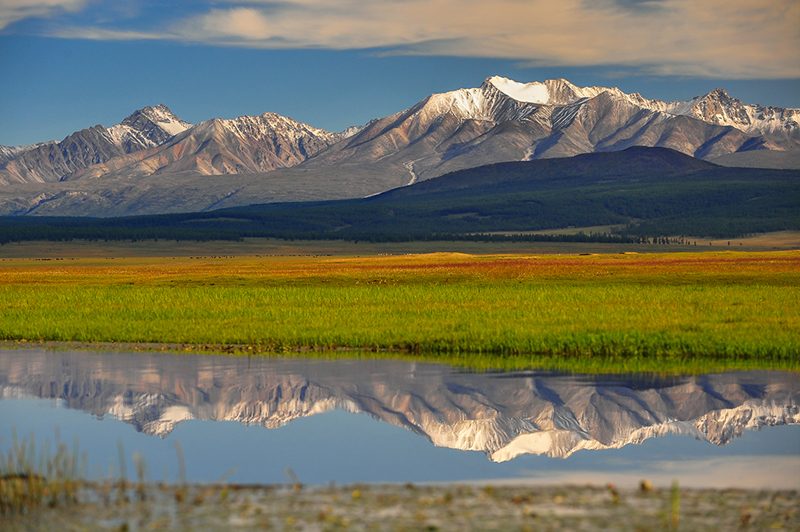
Khövsgöl Lake is 136 kilometres long, more than 260 metres deep, and so clear that you can watch the stones fall away beneath a boat. It sits in the far north against the Russian border, ringed by larch forest and mountains, and it holds most of Mongolia’s fresh water.
Getting there
Murun, the provincial capital, is a flight of about ninety minutes from Ulaanbaatar. From the airstrip it is a paved drive of around two hours north to Khatgal, the village at the lake’s southern tip. Driving the whole way from the capital is possible, and some guests do it as part of a longer loop through the Khangai, but it is two long days. Most fly. Our Land Cruiser and driver meet the flight, and the journey begins with the first view of the lake from the rise above Khatgal. The water is a blue that stops everyone.
Khatgal and the lake shore
Khatgal is a small timber village with a harbour, a few shops and a Soviet-era past as a lake port. From here the western shore runs north for 100 kilometres on a track, and the camps and family gers sit in the meadows between forest and water. The lake is cold, even in August, and people swim anyway, briefly. Days are spent on horseback along the shore, on a boat out to the islands, walking up into the larch for the view, or doing nothing much at a table by the water. Fishing is possible with a permit and is catch and release for the lake’s grayling and lenok. Evenings are long. In June the light lasts past ten.
The taiga and the reindeer families
Northwest of the lake, over a pass and a day’s ride into the forest, live the Dukha, the reindeer herders. There are only a few hundred of them and they move camp with the seasons, keeping their reindeer for milk, transport and, occasionally, meat. Reaching them means driving to Tsagaannuur, then riding for a day, sometimes two, through bog, forest and river crossings, with a horse guide from the community, and sleeping in their conical tents. It is the hardest journey we offer in the north and the one people write to us about years later. You milk reindeer at dawn. The children ride them to fetch water. We only take guests who are fit for the saddle, and we always go with the families’ agreement, arranged in advance.
The Ice Festival
In early March the lake freezes to more than a metre and the Ice Festival is held on the ice near Khatgal. Two days of horse-sledge races, skating, a tug of war, ice sculpture, shamans’ ceremonies, a wrestling ring marked out on the surface and, at the end, a procession of vehicles out onto the lake. It is cold: mornings around minus 25, afternoons around minus 10 in the sun. It is also bright, quiet and completely unlike the summer. We stay in a heated lodge, drive on the lake in the Land Cruiser, and visit families who winter along the shore. The domestic flights run and the road from Murun is clear. Pack for real cold and it is a joyful few days.
Wildlife and the forest
This is the southern edge of the Siberian taiga, and the animals belong to it: elk, wild boar, sable, occasionally bear and wolf, and a great many birds along the lake in migration. The larch forest turns gold in the second half of September, which is the other season we push guests towards. Midges and horseflies are present in July and August, especially in the wet meadows, so bring repellent and a head net if you are sensitive to bites. Nights are cold at any time of year.
When to go
Mid-June to mid-September for the lake in summer. Late September for the gold larch and empty shore. Early March for the Ice Festival. May can be beautiful and can also be snowbound, and we tell you honestly when it is which. Most camps close from October to May.
Talk to us
Khövsgöl on its own is a week. With the reindeer families it is ten days. With the Khangai and the Orkhon Valley, where our ger camp sits, it is two weeks by road and a fine one. We design private journeys only. Write to us and someone who lives here replies within four hours in office time. No price list until we have talked.